
Why everyone starts with the sphere
It is not laziness, it is arithmetic. Knowing whether two spheres touch is a matter of comparing the distance between centres with the sum of the radii. One calculation, one contact per pair, and the most generous time step the method allows. No other shape comes close to that economy, which is why DEM became practical with spheres and still runs fastest with them.
The trouble is that the sphere has a property almost no real material has: it rolls. A grain of sand, a pellet, a tablet or a lump of ore tumbles, slides and locks against its neighbour. A smooth sphere spins with no resistance. And much of what we call "granular behaviour" comes precisely from that resistance to spinning and that tendency to lock.
What a clump is
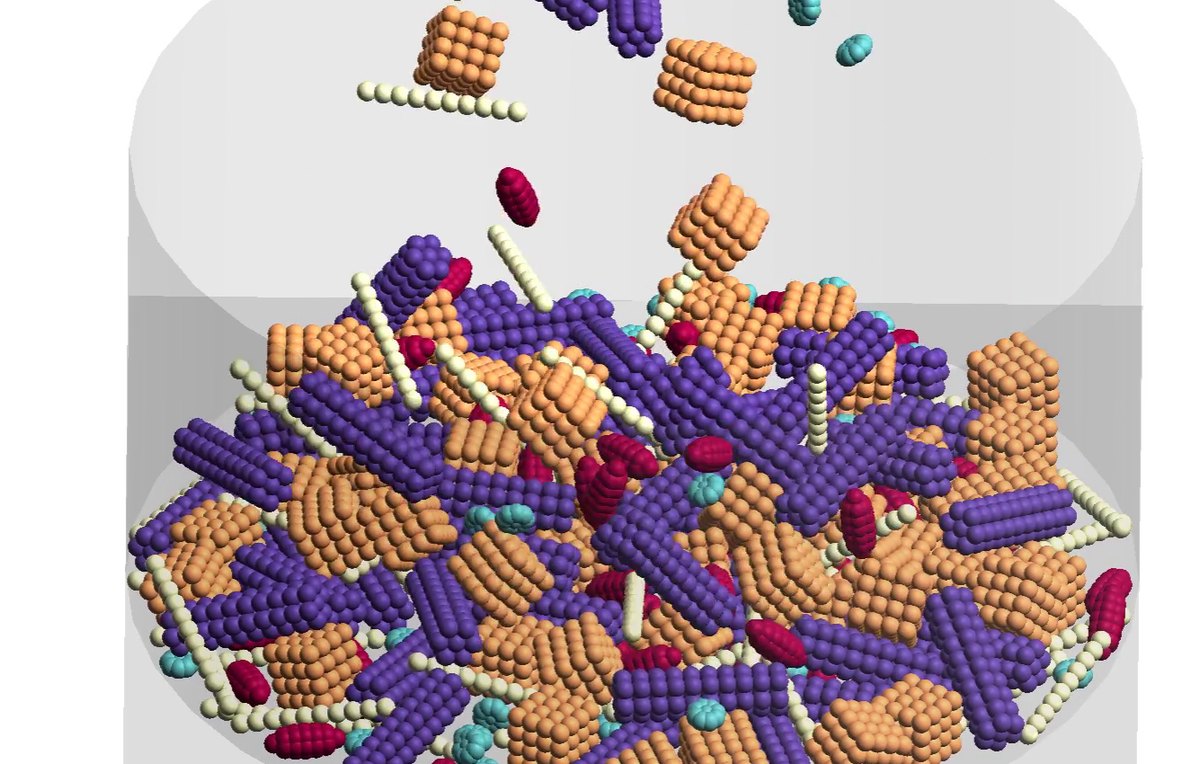
A clump is a set of spheres glued together rigidly, with overlap allowed between them, that moves as a single body. It has its own mass, centre of mass and inertia tensor, and it rotates the way the real shape would. The clever part is that contact stays sphere-to-sphere: the solver does not have to learn any new geometry. It only needs to know that those five spheres belong to the same body and to sum the forces at the centre of mass.
The result is a particle that locks, tumbles and aligns, while keeping all the contact machinery that already works for spheres.
Where the sphere lies
That interlocking is what shows up, in disguise, in each of the cases below.
1. Angle of repose
The classic example. A pile of smooth spheres collapses at low angles, because each sphere rolls off the pile as soon as the slope beats friction. Angular materials stand at much steeper angles, held up by the interlock between particles. If you try to reproduce an ore pile with spheres and realistic friction, the angle comes out too low; if you raise friction until the angle is right, the rest of the simulation goes wrong.
2. Arching and blockage in silos
Particles that interlock form stable arches over a silo outlet. Spheres form arches too, but only over outlets that are very small relative to their diameter. Simulating with spheres a material that bridges in practice gives a dangerous answer: the silo "discharges fine" on screen and blocks in the plant.
3. Torque and power in mixers and mills
Shearing a bed of clumps costs more than shearing a bed of spheres, because on top of friction the particles have to be unlocked. That shows up directly in rotor torque. Anyone sizing a motor from a sphere simulation tends to underestimate the power needed.
4. Packing and bulk density
Equal spheres settle randomly at around 63% solids fraction, and there is not much to be done about it. Rods align and pack differently; plates stack; irregular shapes leave voids. If bulk density is part of the answer, the sphere has no way to get it right.
5. Orientation
A sphere has no orientation, so it cannot align with the flow, lie flat on a belt or jam sideways in an opening. Fibres, tablets, elongated pellets and biomass live on that. For these materials the sphere is not a rough approximation; it is a different physics.
Where the sphere is enough
Now the other side, because a clump you do not need is a slow simulation out of vanity.
- Genuinely rounded material. Glass beads, spherical pellets, round seeds, shot. Here the sphere is not an approximation, it is the material.
- Dilute, fast flows. In a transfer chute a particle spends more time flying than locked against neighbours. Shape matters little; restitution and friction matter a lot.
- Throughput through large openings. When the outlet is many times larger than the particle, mass flow rate is dominated by gravity and geometry, and calibrated spheres get it right.
- Design screening. Comparing five hopper geometries to pick one is a sphere job. The chosen one gets refined afterwards, with clumps if needed.
The middle ground: rolling resistance
There is a shortcut that solves a surprising share of cases: keep the sphere and add a torque that resists rolling. It is shape in disguise. With the right coefficient, a pile of spheres stands at realistic angles and the bed gains some of the shear resistance interlocking would provide, with no extra contact cost.
The shortcut has a clear limit. It stops the sphere from rolling, but gives it neither orientation nor outline. It does not create geometric arches over an outlet, does not align fibres, does not change packing. It handles item 1 and helps with 3; it does not solve 2, 4 or 5. That is why BrixDEM ships both features rather than one.
What a clump costs
| Sphere | Clump of N spheres | |
|---|---|---|
| Contacts to check | 1 per particle pair | up to N² per particle pair |
| Time step | set by the particle radius | set by the smallest sphere in the clump |
| Memory per particle | position, velocity, radius | the same, plus orientation, inertia and N spheres |
| Rotation | simple | quaternions and the full inertia tensor |
In practice, a clump of five to ten spheres tends to make the simulation several times slower than its sphere equivalent, and the bill grows fast if the shape needs one small sphere to close a corner, because that sphere drags the time step down. Two defences: use the fewest spheres that still capture what matters in the shape, and combine with coarse-graining when particle count is the bottleneck.
How to do it in BrixDEM
Since version 1.6, the clump is a full citizen of the solver:
- Ready-made types to start without drawing anything: rods, blocks, ellipsoids, tablets and more.
- Clump from STL. Import the real shape and BrixDEM fills it with spheres. You control how many.
- Preview in pre-processing, before spending a second of solver time.
- Automatic time step, computed from the smallest sphere in the clump, so the simulation does not blow up by oversight.
- PSD, calibration, wear and coarse-graining work with clumps just as they do with spheres.
- Validated CPU against GPU, so the result does not depend on where you run it.
Tutorial T4 builds a complete case with clumps and free-body dynamics, from scratch to result.
Rule of thumb
Try sphere and clump on the same case
BrixDEM ships ready-made clump types, clump from STL and rolling resistance in the same solver. Run both and see where shape changes the answer.