
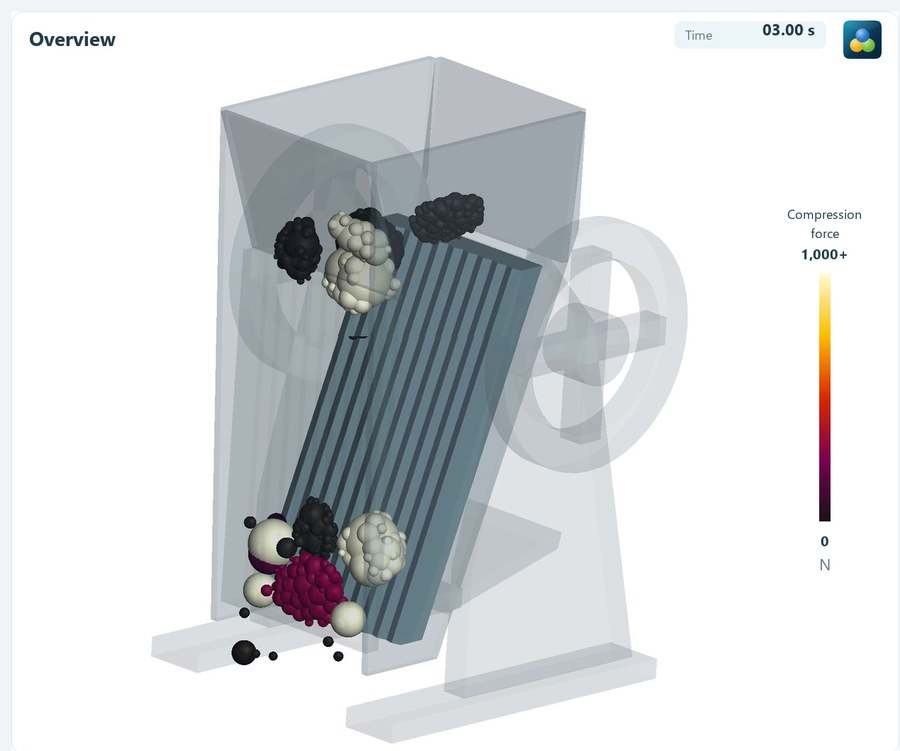
How a jaw crusher works
There are two steel plates face to face. One stays still. The other is driven by an eccentric shaft, with a flywheel that stores energy for the moments of greatest effort. With every turn, the moving jaw closes and opens.
When it closes, it crushes. When it opens, the material drops a little, and a rock that has become smaller fits at a lower point in the V. That cycle repeats until it passes through the outlet. Three measurements define the machine:
- Feed opening: limits the largest rock that can enter.
- Discharge opening: sets the product size.
- Stroke: how far the moving jaw travels on each turn.
Inside the chamber, step by step
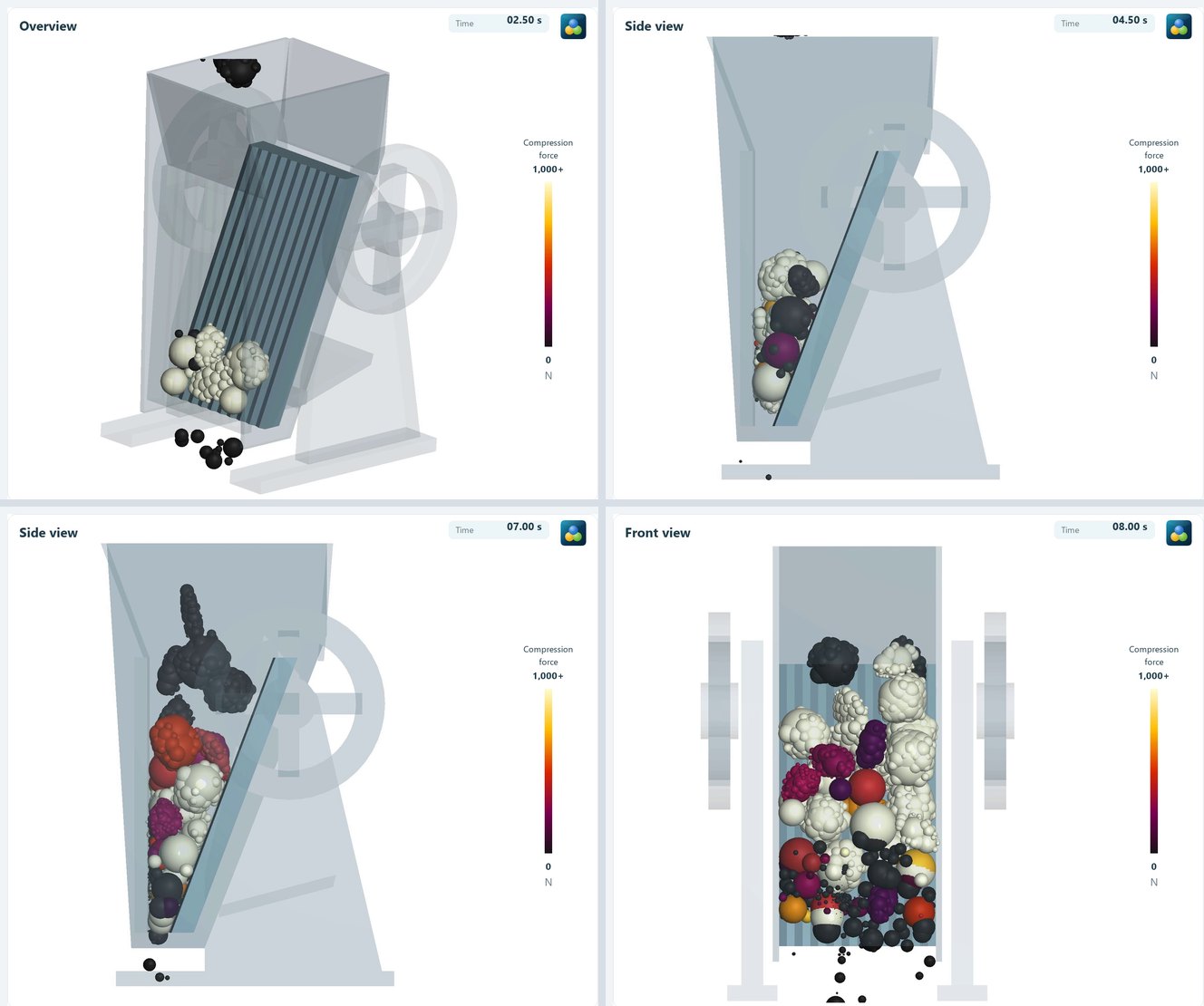
The first rocks drop straight to the narrow part of the V and jam there. By 2.5 s the first pieces are already leaving at the bottom. The next rocks arrive from above and rest on the trapped ones, and the chamber fills: by 8 s, what was a handful of rocks has become a column of material.
The colours show that the load is not shared evenly. Some rocks take a lot of force and others, right beside them, almost none. The rock jammed between the two jaws carries the effort, and the one above just waits its turn.
Crushing happens in jumps
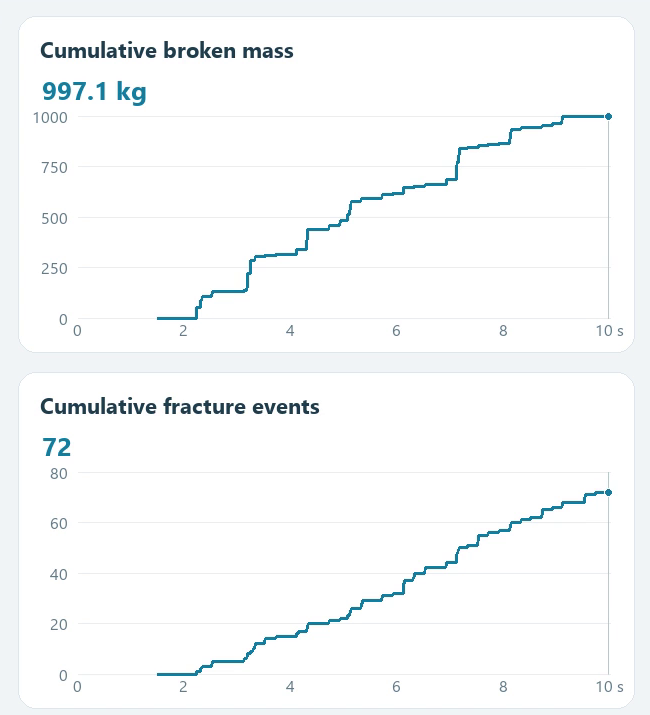
In 10 seconds there were 72 fractures, about nine per second once crushing starts. The number of fractures climbs steadily, but broken mass climbs in jumps: the big steps are whole blocks giving way, and the nearly flat stretches are smaller fragments.
Mass per fracture changes too. Over the first 42 fractures it averages almost 16 kg. Over the next 30 it falls to about 11 kg, because part of the work is now breaking again what has already broken.
Nothing is continuous: the force pulses
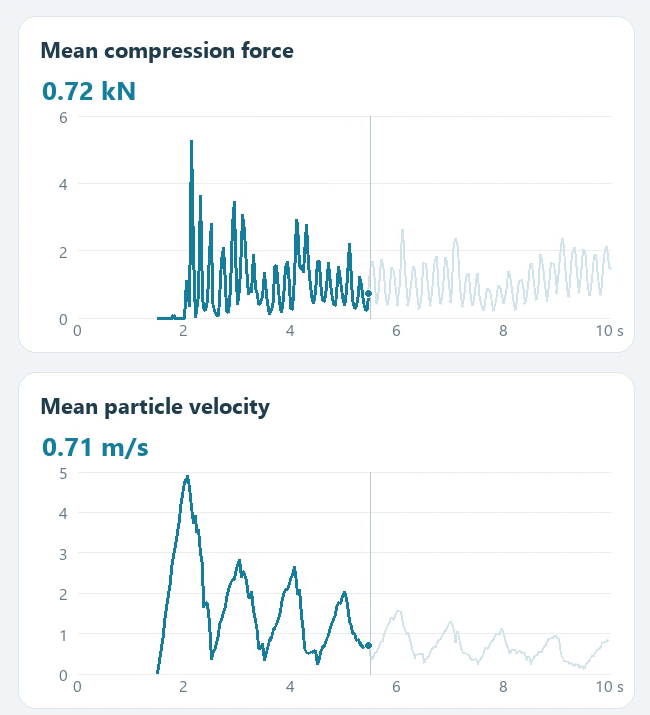
The highest peak of mean force, above 5 kN, comes right at the start, when the first rocks jam. After that the force keeps arriving in short pulses, while the mean rock velocity rises and falls about once per second. For anyone sizing the machine, that rise and fall is what matters: it is what reaches the jaw, the shaft and the flywheel.
What goes in and what comes out
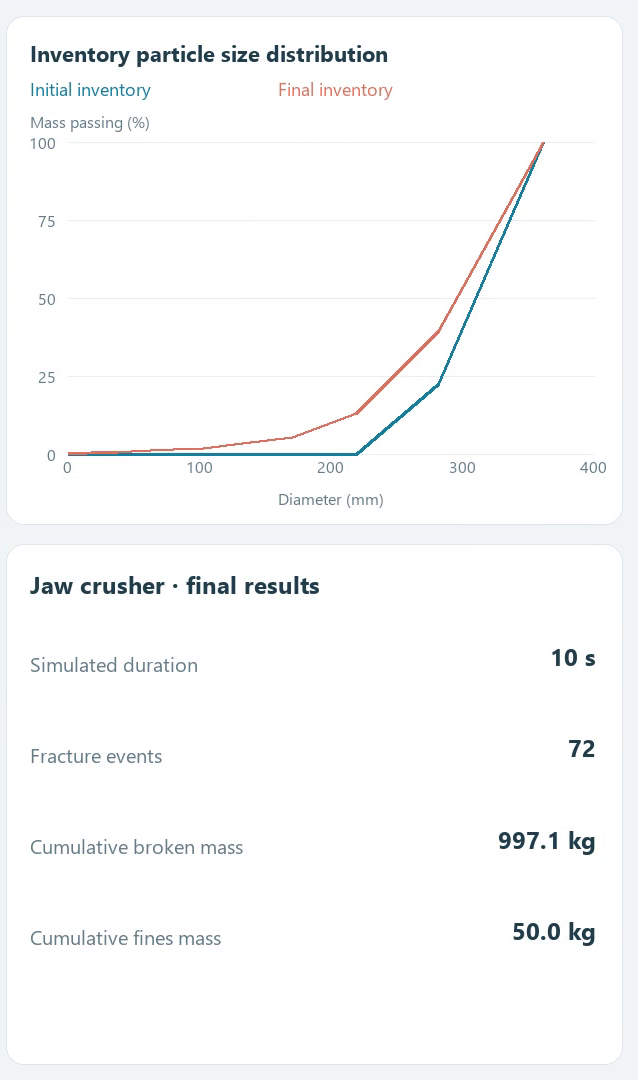
The feed has rocks from about 220 to 360 mm. After 10 s, 13% of the mass inside the chamber is already below 220 mm, and a tail of fine material has appeared that did not exist before, with 50 kg of fines generated.
What you can test before touching the machine
- How the discharge opening changes product size and fines generation.
- The effect of speed and stroke on breakage.
- How much rock the chamber takes before it chokes, and how the feed should be metered.
- Where force concentrates on the plates, to compare jaw profiles.
Simulate your jaw crusher
Build the crusher in BrixDEM or contact us to study discharge opening, feed and product size for your equipment.