
What a rotary valve is
It is a vaned rotor turning inside a housing, forming pockets between the vanes. Each pocket fills at the top, carries the material while it passes sealed against the housing, and dumps it at the bottom. Because the vanes stay in contact with the wall, it also seals the pressure (airlock). It sits under silos, cyclones and filters, and at the inlet of pneumatic conveying.
How it works
Follow a single pocket: it fills at the top, turns sealed carrying the portion, and dumps it when it reaches the bottom. Each pocket delivers one batch. That is why the results are pulsating: the valve doses in packets, one per pocket that passes.
Throughput and dosing
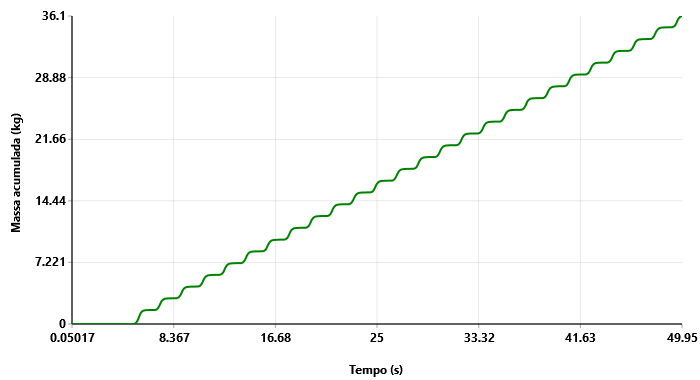
The curve rises in steps, one per pocket. That is 36.1 kg in 50 s. The slope of the straight part gives the throughput: about 0.75 kg/s, or 2.7 t/h. It is this average value that serves for process control, not the instantaneous one, which pulses.
Rotor torque and power
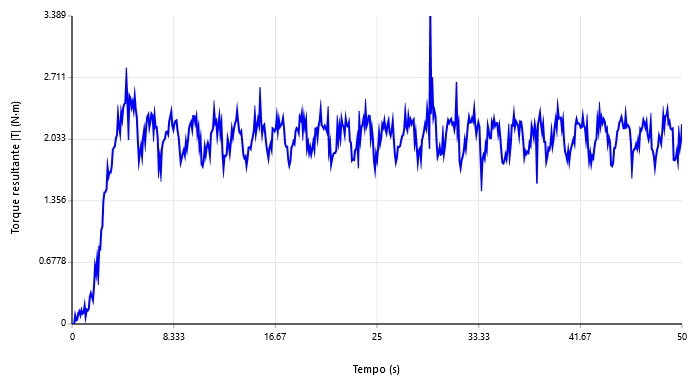
The torque settles around 2.0 N·m (peak near 3.4), and the granular power is around 1.2 W. Careful: this is only the load the material imposes on the rotor. The real motor still overcomes inertia, bearings, the seal and the start-up peak. Size from the peak, not the average.
Liner wear
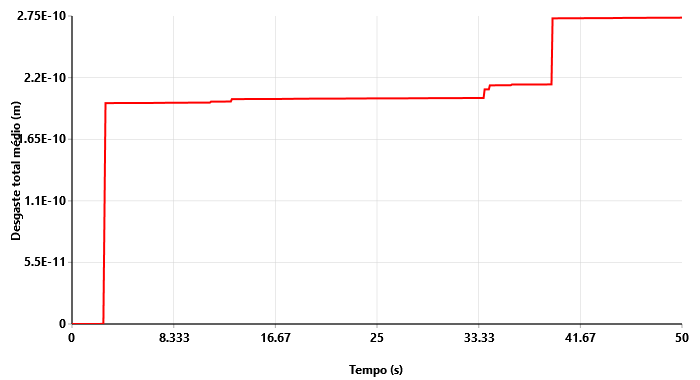
Wear accumulates in steps as the loaded pockets pass the housing. It is the abrasion the wear liner is made to absorb, and DEM shows where and at what rate it wears, helping decide the material, thickness and replacement of the part.
What else this model can deliver
- Fill vs. rotation speed: speeding up the rotor does not always increase throughput. Above a certain speed the pocket does not fill completely and the material is thrown rather than dosed.
- Wear map: beyond the mean value, the abrasion field shows the hot spots on the liner and at the vane tips.
- Segregation: materials with a size range can segregate during filling and discharge.
How to reproduce it in BrixDEM
Import the equipment CAD or draw it in the Sketch modeler, apply the rotation to the rotor, calibrate the material, feed from the top and measure at the discharge. Then export the mass, torque, power and wear curves.
Download BrixDEM and see the video tutorials and other simulated equipment.
Frequently asked questions
What is the valve's real throughput?
It is the slope of the cumulative mass in steady state: about 0.75 kg/s (2.7 t/h). The instantaneous value pulses because dosing happens in pockets.
Does the 1.2 W power size the motor?
No. It is only the load the material imposes on the rotor. Add inertia, bearings, the seal and the start-up peak, and use the granular peak as a base.
Do I need the equipment CAD?
It helps, but it's not required. You import the CAD or draw the valve directly in BrixDEM's Sketch modeler.
Reference: valve CAD model, available on GrabCAD.
Simulate your own valve
BrixDEM is free to download and imports your CAD. Measure throughput, torque, power and wear on your own equipment.